BambooHR’s Brian Crofts on AI, Trust Layers, and Why HR Software Is Being Rewritten in Real Time
When Brian Crofts joined BambooHR as Chief Product Officer in 2022, the mandate wasn’t simply to move faster.
By then, BambooHR had already built one of the most recognizable products in the mid-market HR software category. The company was known for its ease of use and approachable employee experience, making HR software feel simpler than many alternatives on the market.
But the next stage of BambooHR’s product strategy required something broader.
“I think the clearest mandate to me was kind of going from maybe a single product to multi-product to platform,” Brian said in a recent interview with Brett Ungashick from OutSail.
That shift had already started before Brian’s arrival. BambooHR had acquired payroll capabilities years earlier, then spent time bringing HR, payroll, and benefits closer together into a more native experience. In Brian’s words, the work was less about the “syncing of data” and more about building an “integrative, native payroll HR, ben admin experience.”
That platform work matters more now because the market is entering a very different phase. BambooHR is no longer just thinking about expanding modules or improving workflows. The next product era is being shaped by AI agents, autonomous systems, and a fundamentally different expectation of what HR software should be able to do.
“Now I think we’re in that platform AI era,” Brian said.
Key takeaways
- BambooHR is evolving from a multi-product platform toward a platform AI strategy designed to better support HR teams.
- As software capabilities evolve quickly, teams should prioritize the speed of learning alongside the speed of shipping new products.
- Strong permissions and trust layers become increasingly important as software interfaces fragment and AI systems become more autonomous.
- AI agents could shift the value of HR software from providing tools to helping customers achieve operational outcomes.
Why BambooHR’s AI roadmap matters to HR teams
One of the most interesting parts of the conversation was how Brian described the responsibility BambooHR feels feels to its customers.
Most HR teams aren’t trying to DIY their own AI transformation by building their own agents, stitching together foundation models, or deciding which technical architecture will still matter six months from now. They want their core systems to help them make sense of the shift.
Brian said BambooHR hears that directly from customers.
“Your roadmap is our AI strategy,” he said.
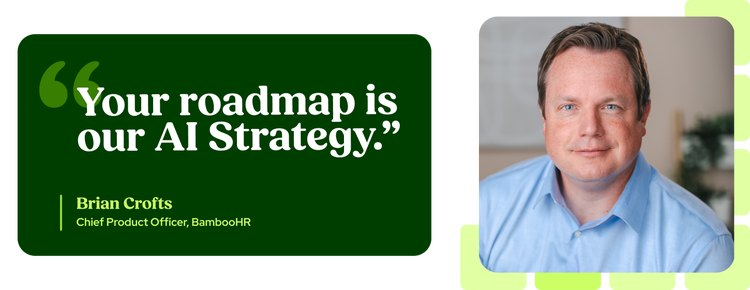
That line says a lot about where the market is right now. HR leaders are under pressure to explain how they’re using AI, but many don’t want to own the technical experimentation themselves. They want vendors they already trust to absorb the complexity and translate it into usable products.
Brian described BambooHR’s own AI transformation in three parts:
- First, how the company changes the way it works internally
- Second, how it changes the way software gets built
- Third, what BambooHR actually ships to customers
The product is the visible part, but the internal operating model has to change too.
“The way we approach the work has to be totally different,” he said. “The way we think about value exchange is different.”
Customers are asking BambooHR to help define what AI should mean for HR operations.
How BambooHR builds AI products as technology changes
One of the hardest parts of building with AI right now is that the technology doesn’t stay still for very long.
A few years ago, RAG (retrieval augmented generation) felt like the center of the conversation. Then attention moved to agents. Then MCP (Model Context Protocol). Then new model capabilities, new orchestration patterns, and new assumptions about what software should be able to do.
So how is a product leader supposed to build confidently in a world where the foundational technology keeps shifting?
His answer was one of the more thoughtful moments of the interview.
He described the need to operate with “loosely held” assertions. Not uncertainty for its own sake, and not overconfidence disguised as strategy. Something in between.
“[I need to say], ‘here’s my belief, here’s an assertion that I have that’s loosely held,” he said. “In this point in time, if this is how we see the future, this is how we think it’s gonna happen. And based on that, this is how we’re building.”
The important part is that those beliefs have to be tested constantly. Brian talked about the speed at which teams can now build prototypes, put them in front of customers, and learn whether their assumptions hold up.
“I think it’s about the velocity of learning versus maybe even the velocity of shipping new product,” he said.
That feels like the right distinction. For a long time, software companies were rewarded for shipping more. More features, more workflows, more modules. In this environment, the ability to experiment, learn, and adapt may matter just as much.
Brian summarized the mindset with an internal phrase: “learn at all, not know at all.”
It’s a simple line, but it captures something real about this moment. Companies that pretend to know exactly where AI is going may look confident in the short term. Those that stay curious and keep learning may be better prepared to adapt as the technology changes.
How AI is changing the role of the HR software interface
BambooHR has historically differentiated itself through its user experience. For many buyers, especially in the mid-market, BambooHR has been the approachable option in a category that can often feel intimidating.
That raises an interesting question in the AI era.
If more work starts happening through chat interfaces, Slack, embedded agents, or other conversational experiences, does the value of a great UI compress?
Brian didn't dismiss the concern. He said BambooHR talks about it often.
“I do think that one of our assertions is that the interface will continue to fragment,” he said.
That doesn’t mean UI stops mattering. Power users will still need full systems. HR admins will still need places to configure, review, govern, and understand what’s happening. But the everyday employee experience may look very different.
If an employee can ask for a pay stub in Slack, they may not care where the answer technically comes from. If a manager can start an action from a chat interface, they may never think about the underlying system at all.
But that creates a new problem.
The software still has to know what should be allowed.
Brian gave a simple example. An employee might be able to ask for their own pay stub in another interface. But can they approve payroll? Can they create a payroll exception? Can they ask for their manager’s salary? Of course not.
That’s where BambooHR’s trust layer becomes more important.
“Do I trust that this system is going to behave accordingly in an autonomous way where it understands and respects execution authority?” Brian said.
That phrase, “execution authority,” is a useful way to think about where HR software is heading. In a traditional system, the UI helped constrain what users could do. In an agentic system, the controls have to sit deeper. Permissions, roles, compliance, governance, and data structure become more central because the user may not always be operating inside the native interface.
Brian put it plainly: “That’s what I think customers will be paying for is not just a nice UI.”
What AI companies may underestimate about HR software
The conversation eventually turned to frontier AI companies and whether they might expand into categories like CRM, HRIS, or ERP.
Brian’s view was nuanced. He didn’t dismiss the possibility. In fact, he said it would be naive to assume foundation model companies won’t continue expanding into valuable software categories.
“They’ll look at CRMs, they’ll look at HRS, they’ll look at ERP systems, they’ll look at all of it,” he said.
But he also pointed to the things that are easy to underestimate from the outside.
Payroll is a good example. From a distance, it can look like a calculation engine with a user interface on top. In practice, it is deeply tied to money movement, tax compliance, payroll compliance, employee records, government filings, permissions, and error handling.
“They quickly learn that it’s not just about a simple UI that does a complex, or fairly complex calculation from gross to net on the back end,” Brian said. “It’s a very robust compliance-driven system.”
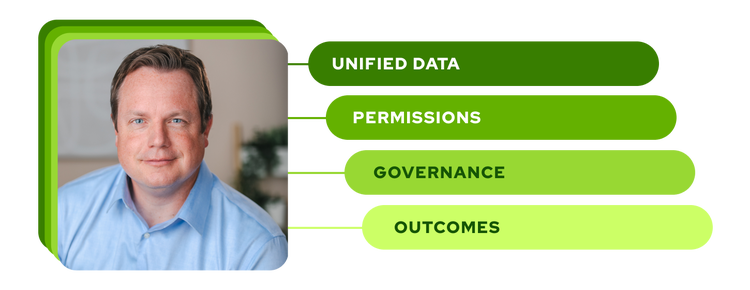
That doesn’t mean HR software companies are immune from disruption. But competing with HRIS companies involves more than shipping a software platform. It means maintaining the system, hardening it over time, handling edge cases, respecting governance, and earning trust in processes where mistakes have real consequences.
That’s why the conversation around AI replacing software can feel too simplistic. Intelligence is only one part of the system. Execution, compliance, maintenance, and accountability matter just as much.
Why customers may start paying for outcomes instead of software
The most forward-looking part of the conversation came near the end, when Brian discussed where SaaS business models may be heading.
For years, many software companies tried to avoid services. Services were lower margin, harder to scale, and often handed off to consulting partners. The classic SaaS model was to sell the product and let someone else handle the implementation, administration, and ongoing operational work.
Brian sees that line starting to blur.
He described a world where BambooHR builds first-party agents inside the product, while also using agents to power services that help customers get work done directly. The two sides can teach each other. What BambooHR learns from delivering services can inform the product, and what it builds in the product can make services more efficient.
The end goal isn’t just better software. It’s getting the work done.
“Just take it, just do all the work for us and then we’ll pay you for payroll being done,” Brian said, describing what customers are increasingly asking for. He mentioned examples like payroll, onboarding, rolling out a new policy, and changing a compensation planning cycle.
That’s a different value exchange than traditional SaaS.
Instead of buying access to tools, customers may increasingly pay for outcomes. Payroll completed. Employees onboarded. Policies updated. Workflows handled. The software becomes less of a place where work happens and more of a mechanism for getting that work done.
Brian summarized the direction well: “[As a practitioner], I don’t do the work, I just make sure I know the policy and I can orchestrate and I can kind of oversee everything, but the work is just happening.”
That may be one of the bigger shifts AI could bring to HR software. The value of the system moves from helping humans click through the work to helping humans govern the work as agents execute more of it.
Final thoughts
The takeaway from the conversation wasn’t that BambooHR has every answer already mapped out.
It was almost the opposite.
Brian was comfortable acknowledging that the market is changing too quickly for rigid certainty. What mattered more was the approach: build around trust, learn quickly, stay close to customers, and keep returning to the parts of HR software that will remain important no matter how the interface changes.
Good employee records will still matter. Compliance will still matter. Permissions will still matter. Payroll accuracy will still matter. Governance will still matter.
The interface may fragment. Workflows may become more autonomous. The pricing model may shift closer to outcomes. But the need for a trusted system underneath all of that doesn’t go away.
In some ways, AI may make that trusted foundation more important than ever.